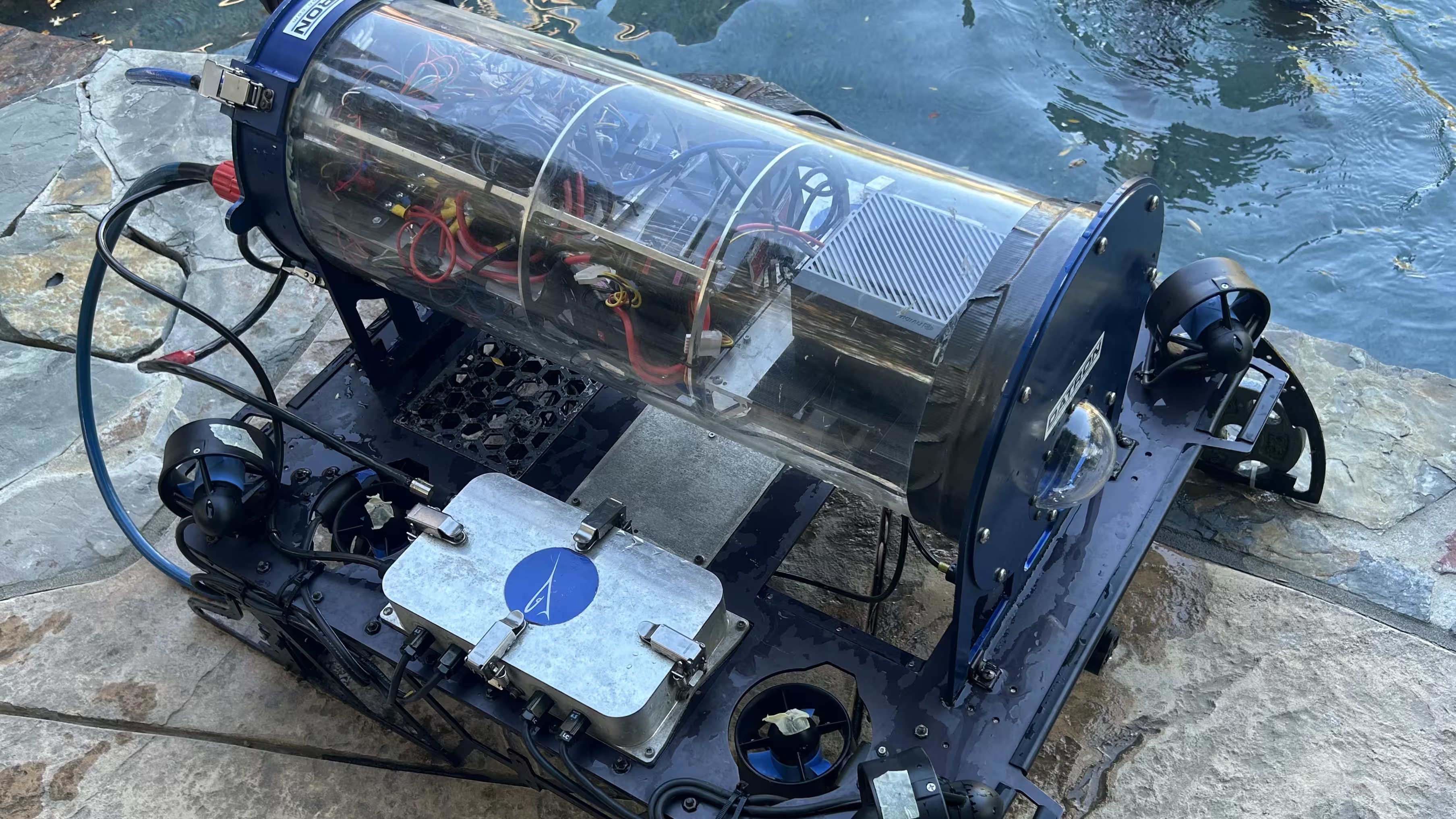
Amador Valley Robotics builds an autonomous underwater vehicle for RoboSub, an international competition where a submarine completes navigation, vision, and manipulation tasks with no tether, radio link, or pilot. I lead its software: controls, firmware, and perception.
Led a seven-engineer software team spanning controls, firmware, and perception, and coordinated with the electrical and mechanical teams through Interface Control Documents, so subsystems can be developed and tested in parallel.
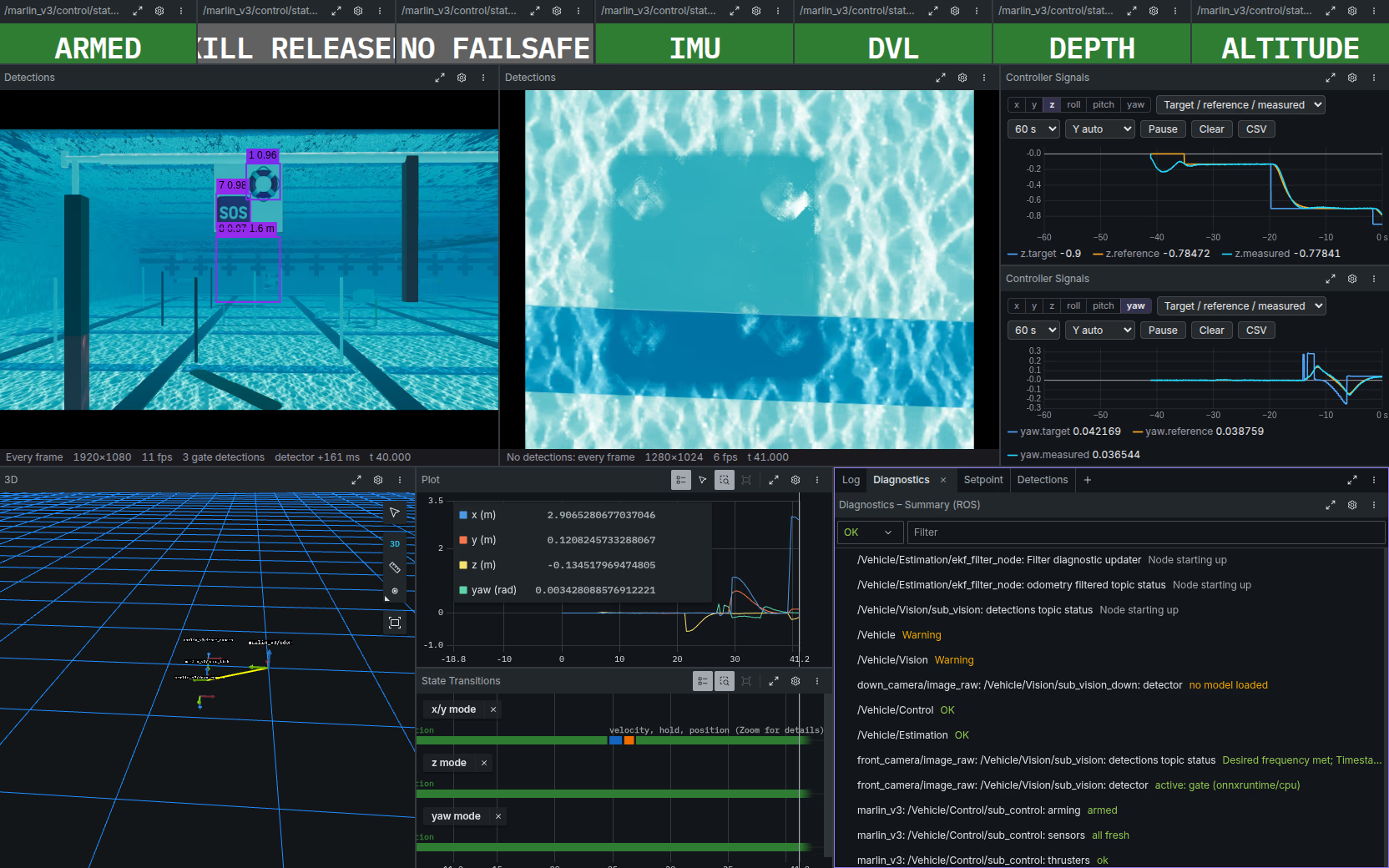
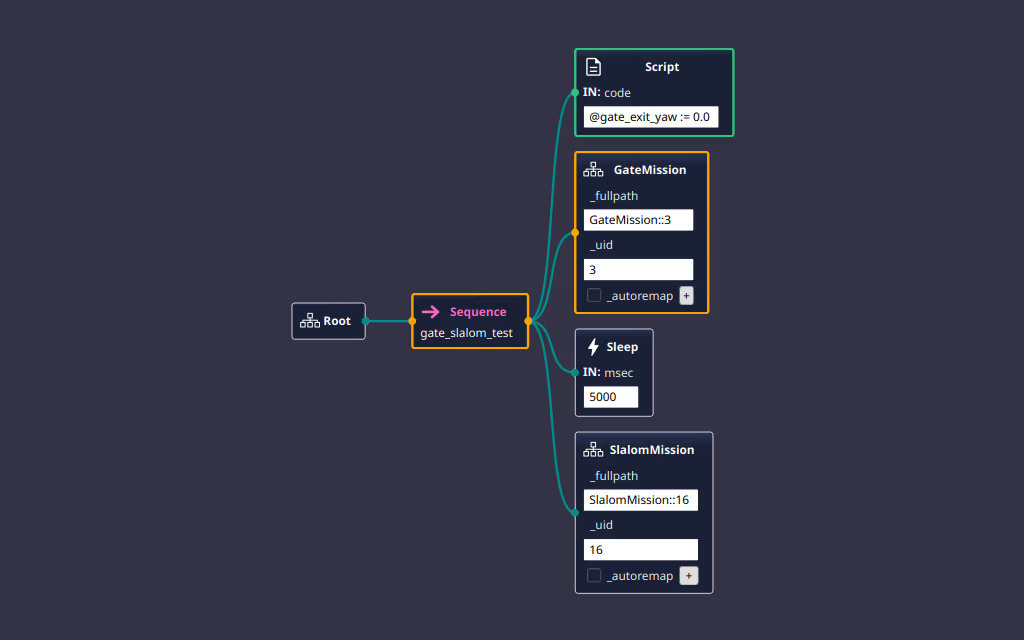
Directed the migration of the autonomy stack to ROS 2 Jazzy and the Stonefish marine simulator, so controllers and mission logic are validated before they reach the pool, and contributed C++ and OpenGL fixes to Stonefish upstream.
Replaced the six-axis PID controller with an LQR controller designed in Simulink, which handles the coupling between axes that independent PID loops ignore, and reformulated thrust allocation as a minimum-power quadratic program that keeps full 6-DOF control with two of eight thrusters out.
Wrote Zephyr RTOS firmware for sensor acquisition and actuation over CAN and UART, and architected the MAVLink link to the Jetson AGX Orin, keeping hard real-time and safety functions on the microcontroller.
Trained YOLOv11 models to detect competition props, with OpenCV post-processing that holds up as color and contrast shift from pool to pool, and built Foxglove extensions for teleoperation and live model inspection.
Stonefish: simulated gate run on ROS 2Foxglove: live detections + controller signalsMission behavior tree in Groot2
ML/AI Intern
Nov 2024 - Present
International Business Consultants (IBC)
I build the machine learning layer of Ethereal Agility, IBC's application lifecycle management product on ServiceNow, which turns a team's Jira history into delivery forecasts and staffing recommendations.
Architected the ServiceNow platform layer: table schemas and data models, Script Includes and Business Rules for server-side logic, Flow Designer and IntegrationHub for orchestration, and prediction endpoints exposed through role-based dashboards that scope each team to its own data.
Built ALM data pipelines from Jira and Atlassian over REST APIs and webhooks, with incremental ETL that syncs only changed records rather than re-ingesting full history, and a schema mapping that normalizes sprints, issues, story points, and assignees into a consistent, model-ready form.
Engineered predictive features - velocity, lead and cycle time, work in progress, and skills signals joined against internal skills inventories - since raw story-point totals alone are weak predictors of delivery timing or staffing fit.
Developed timeline and allocation models, using regression and time-series methods to forecast delivery dates and constrained optimization to recommend staffing. Containerized them as REST services and integrated their outputs back into ServiceNow, so recommendations appear on the records where decisions are made.
Cluster 11: Brain-Inspired Machine Learning
Jul 2025 - Aug 2025
COSMOS · UC Santa Cruz · <7% acceptance rate
COSMOS is a four-week residential program run by the University of California. Cluster 11 covered brain-inspired machine learning: computing modeled on biological neurons, with energy efficiency as the central goal.
Studied spiking neural networks, which encode information in the timing of discrete spikes rather than in dense floating-point activations. Because computation happens only when a neuron fires, they map naturally onto low-power, event-driven hardware.
Explored memristive in-memory computing, where each weight is stored as a device's conductance and multiply-accumulate operations occur in the analog domain, avoiding much of the memory-to-compute data movement that dominates energy cost in conventional hardware.
Studied ternary quantization, which constrains weights to -1, 0, and +1 so that most multiplications reduce to additions, subtractions, or skipped operations.
Applied these techniques to conventional models on classification and regression tasks and benchmarked them against full-precision baselines to quantify where efficiency gains came at no cost and where they traded off against accuracy.
Research Assistant
Dec 2024 - Jun 2025
San Jose State University · San Jose, CA · Assistant for a graduate student under Dr. Robert Chun
Supported graduate research on a career recommender built on RIASEC interest types. It combines users' stated preferences with eye-tracking data, since stated and revealed interests often diverge.
Engineered the recommendation pipeline, fusing LLM-guided preference elicitation with implicit eye-tracking signals captured while users browse, and ranking career matches on the combined evidence rather than on either signal in isolation.
Built the gaze data path on the Tobii C++ SDK: a C++ publisher streams samples over ZeroMQ PUB/SUB to a Python subscriber for feature extraction and scoring. The message-queue boundary keeps capture in native code and modeling in Python's ML ecosystem, and decouples the two so a slow consumer cannot stall acquisition.
Developed the Flask backend with socket-based communication to a Vite/React frontend, streaming gaze-driven updates to the interface in real time rather than after a session ends.
ACE Coding is a student-run nonprofit teaching programming at three middle schools. As co-president, I oversee its branches, student instructors, and partnerships with school administrators.
Led regular programming sessions at Hart, Harvest Park, and Pleasanton middle schools, using a curriculum designed for students writing their first lines of code.
Oversaw operations across all three branches and served as the liaison between Amador Valley and the middle school administrations, maintaining the institutional relationships a volunteer program depends on to continue from year to year.
Organized ACE Code Day, a one-day event that brought together 150+ students and 20+ lecturers across 14 workshops on software and engineering topics.
Vice President & Secretary
Aug 2024 - Present
Amador Valley Web Development · Pleasanton, CA · AV Web Dev
AV Web Dev builds and maintains websites for clubs and organizations. As vice president and secretary, I manage client relationships, direct technical decisions, and run the club's administration.
Managed multiple commissioned projects concurrently as the primary point of contact for each client, turning their requirements into a scope a student team could deliver within the school calendar.
Made the key technical decisions on stack and hosting, prioritizing sites each client could maintain on their own after handoff, and contributed substantially to the code and design.
Coordinated with school administration and managed the documentation that keeps the club in good standing and its projects approved.
02
Projects
Enhancing Disaster Rescue
Dec 2024 - Mar 2026
Localizing cellular devices via RF signal analysis
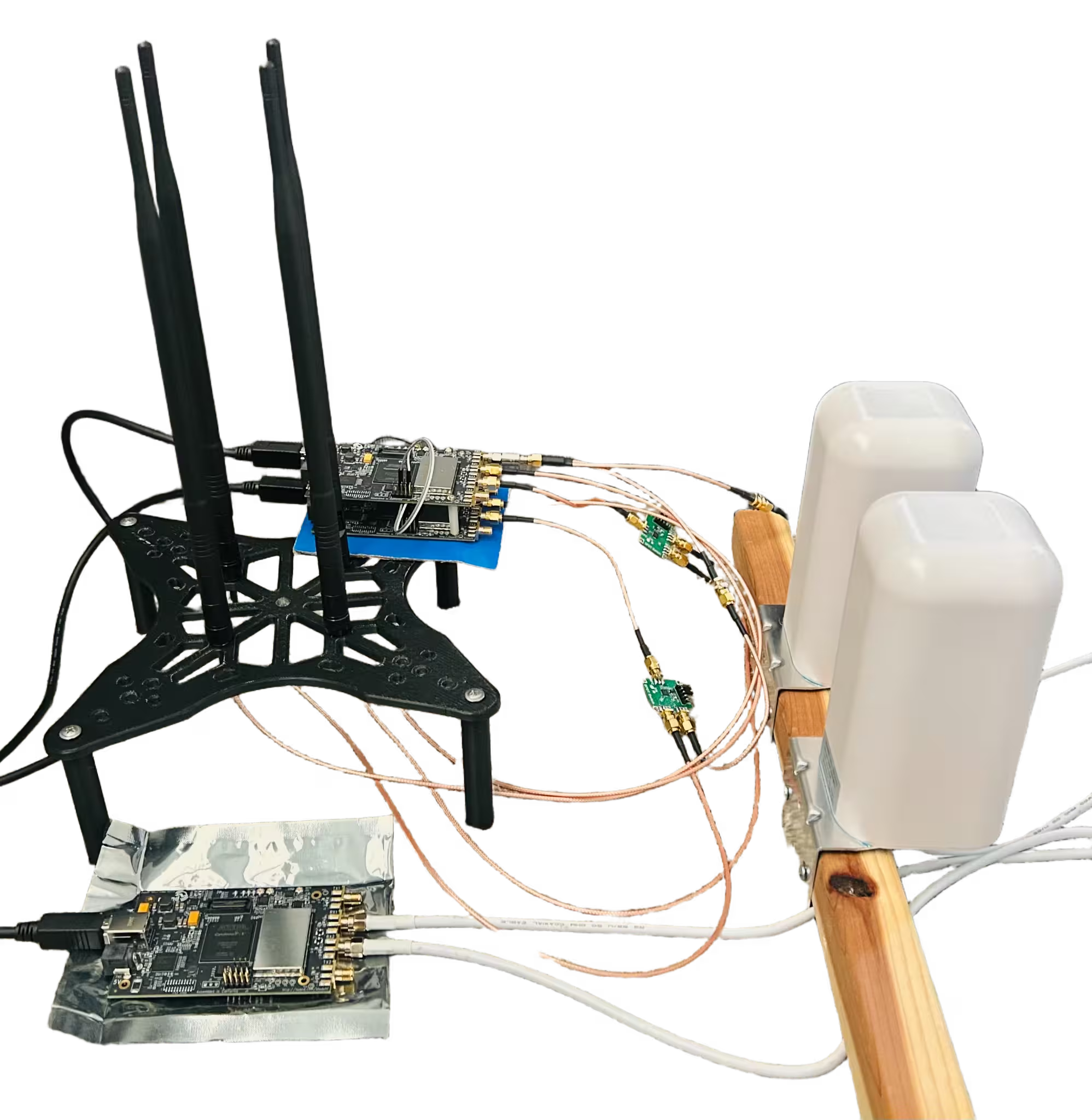
In a building collapse, a trapped person's phone keeps transmitting even when they cannot call for help. This passive, receive-only system detects those emissions and estimates their direction, with no line of sight or cooperation from the device required.
Prototyped the localization system on two bladeRF 2.0 micro xA4 software-defined radios and a four-element monopole array, detecting and triangulating cellular emissions in visually obstructed environments. Operating receive-only adds no load to the networks first responders rely on and requires nothing from the target handset.
Implemented the DSP chain in high-throughput C++ for IQ sample acquisition and processing, exposed through custom GNU Radio blocks in Python that produce bearing estimates at about 3 Hz. Keeping the sample-rate-critical loops in C++ and only the flowgraph orchestration in Python lets the pipeline sustain the radios' data rates.
Validated the system across multiple environments to a median bearing error of about 15°, and stress-tested it under multipath and low SNR - the defining conditions of a collapse site, where reflections off walls and debris arrive as delayed copies of the signal from the wrong direction.
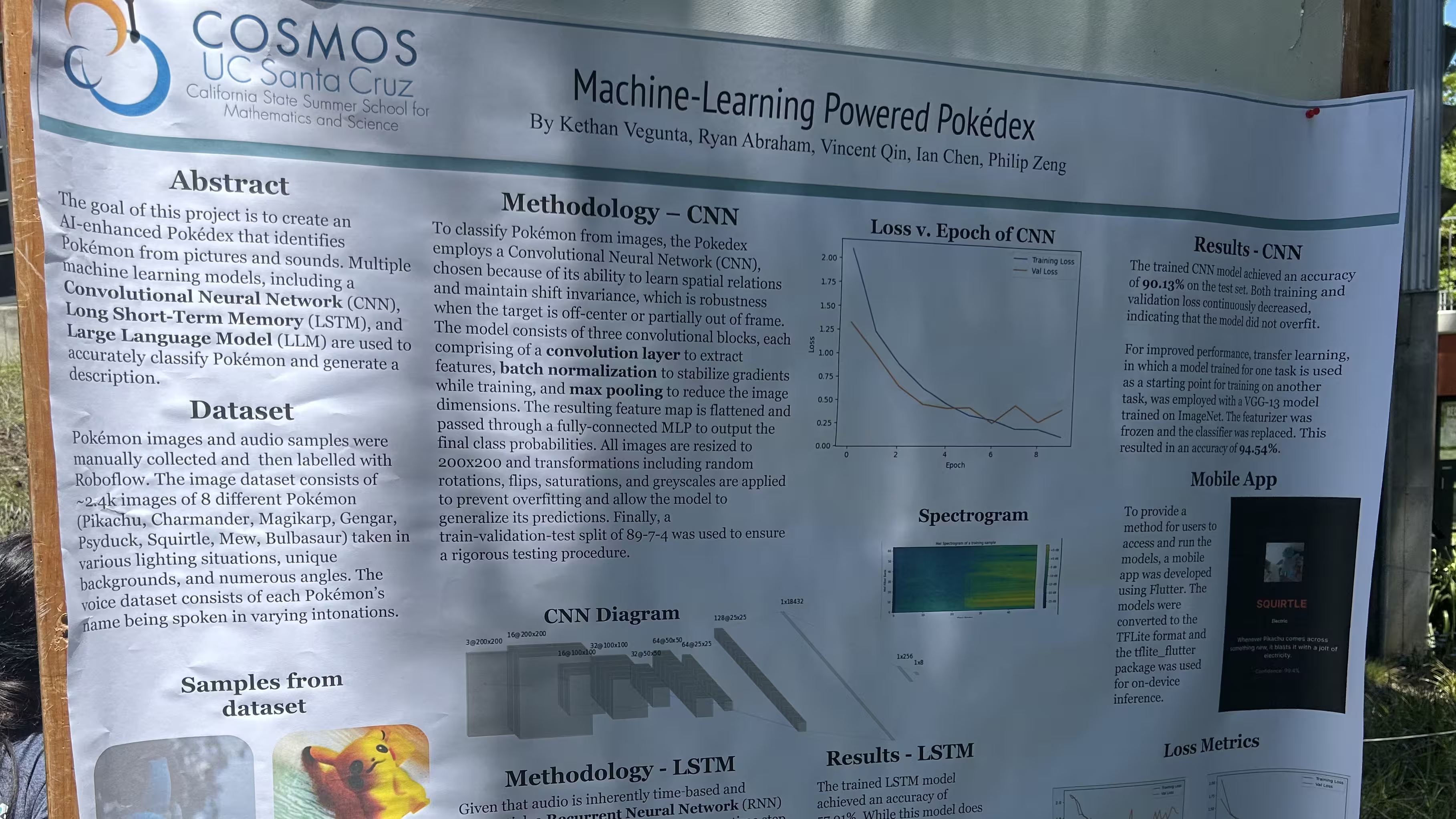
A Pokédex that identifies a Pokémon from a photo or a recording of its cry, then uses an LLM to write its encyclopedia entry.
Built the pipeline end to end: CNN image and audio classifiers trained on 11,000 collected samples across six classes, feeding an LLM that writes an encyclopedia entry for the predicted class instead of returning a bare label and confidence score.
Shipped a Flutter app that runs inference fully on-device on iOS with ONNX Runtime - no server round trip, so it works offline - alongside a web client served through the Hugging Face Spaces API.
Used confusion-matrix analysis to direct each iteration: the specific class pairs being confused determined where to collect more data, which architecture to keep, and what to change in training.
A web app that annotates table tennis games live, tracking the ball and reading the scoreboard to produce rally statistics. The core challenge was detecting a small, fast, motion-blurred ball quickly enough to follow it in the browser.
Trained a custom YOLOv5 model for ball detection and tracking on the OpenTTGames dataset, then pruned and quantized it and deployed it client-side through ncnn compiled to WebAssembly, sustaining over 10 FPS in the browser. Tracking depends on inference keeping pace with the ball, so compression was a requirement for the tracker to work at all, not a final optimization.
Trained a Detectron2 Mask R-CNN instance segmentation model to identify the table, scoreboard, and players, converting raw detections into live rally statistics - rally length, and score changes read directly from the scoreboard rather than inferred from play.
Converted the source annotations into YOLOv5 and VGG formats for the two models and published both processed datasets on Kaggle: ball detection and scene segmentation.
Won 1st place in Embedded Devices at the Alameda County Science and Engineering Fair for Enhancing Disaster Rescue, a passive RF system for locating cellular devices in collapsed structures, and received the U.S. Air Force and Stem4All Special Awards.
Lockheed Martin Code Quest - 1st Place, Advanced Division
2026
Sunnyvale, CA
Won 1st place in the Advanced Division of Lockheed Martin's team programming competition against 30+ teams and 90+ competitors, becoming the first team in the Sunnyvale event's history to score above 600 points.
3rd Place, Coding - solved algorithmic problems in Python and C++ under competition conditions, without internet access.
8th Place, Software Development - built an assistive application for deaf and hard-of-hearing users that combines digital signal processing and machine learning to localize and classify nearby sounds.
CSEF - 3rd Place, Embedded Devices
2025
Thousand Oaks, CA
Won 3rd place in Embedded Devices at the California Science and Engineering Fair, the statewide competition, for Enhancing Disaster Rescue.
ACSEF - 1st Place, Embedded Devices
2025
Hayward, CA
Won 1st place in Embedded Devices at the Alameda County Science and Engineering Fair for an earlier prototype of Enhancing Disaster Rescue, and received the American Vacuum Society Special Award.
5th Place, Coding - solved algorithmic problems in Python and C++ under competition conditions, without internet access.
9th Place, Software Development - built a tool that uses machine learning to forecast crop yields and identify opportunities for farmers to improve them.
Designed and developed a website that helps homeowners adopt clean energy, consolidating practical guidance, incentive programs, and tax rebate information in one place.
CAN · I2C · SPI · UART · OSI Model · Ethernet · TCP/UDP sockets · Multicast/DDS discovery · WebSockets
05
Education
Amador Valley High School
Graduating May 2027
PLTW Pathways: Computer Science · Pleasanton, CA
GPA
4.0 UW · 4.50 W
Relevant coursework
AP Calculus BC · Honors Pre-Calculus · Algebra II · AP Computer Science A · Cybersecurity · Advanced Computer Science for the Contemporary World · AP Physics C: Mechanics · AP Physics C: Electricity & Magnetism · AP Chemistry · AP Biology